Game creation guide
How to make a tower defense game
A tower defense game has four parts: a path enemies walk along, waves that send enemies down it, towers the player places beside it, and an economy where kills pay for more towers and upgrades. Build the path and one enemy first, then one tower that targets correctly, and only then add more enemy types, more towers and the wave table that ties them together.
- Template: Tower defense
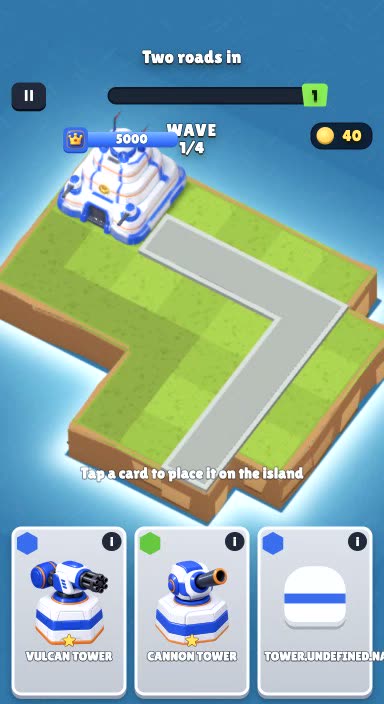
- Play an example: Island Rush
- Updated
A prompt to build your first version
Copy it into EvonX, or send it from the box at the end of this page. Change the theme, the numbers and the twist to make it yours.
Create a tower defense game on a small island with a road to my base, waves of goblins, fast wolves and armored orcs, a boss on the last wave, cannon, rapid-fire and lightning towers I place beside the road, gold from kills, tower upgrades, 12 levels and a level complete screen.
Other directions to try:
- A space tower defense where I build turrets on asteroid tiles and drones fly a fixed route to the station
- A tower defense where I choose one of three random tower cards after every wave
How tower defense games work
Tower defense is a game about reading the next threat and spending limited resources before it arrives. Every system exists to make that decision interesting.
The path is the level
Enemies follow a fixed route of waypoints or grid cells from a spawn to the player's base. The shape of the path decides where towers are strongest, which is why level design starts with the road.
Waves are a table, not a timer
A wave is a list of groups: which enemy, how many, how far apart, and after what delay. Writing waves as data lets you balance and reorder them without touching code.
Targeting decides whether towers feel smart
The most common rule is to shoot the enemy furthest along the path, because that is the one about to reach the base. Alternatives such as strongest, weakest or closest make good upgrade choices.
Enemy variety forces tower variety
Fast enemies punish slow projectiles, armored enemies shrug off weak rapid fire, and groups punish single-target towers. If every enemy behaves the same, one tower type wins and the strategy disappears.
Kills fund the next decision
Each enemy pays a bounty. The player spends it on new towers or upgrades between or during waves. The base loses health for each enemy that gets through, and the level ends when the last wave is cleared or the base falls.
Step by step: building a tower defense game
1. Draw the map and the path
Use a grid so placement is simple: road cells, buildable cells and blocked cells. Store the path as an ordered list of cells from spawn to base.
2. Move one enemy along the path
Give it speed, health and damage to the base. Track its progress as distance along the path; you will need this number for targeting.
3. Place one tower and make it shoot
A tower has range, damage and cooldown. Each tick, find enemies in range, pick the one with the greatest path progress, and fire. Get this right before adding a second tower.
4. Add waves as data
Define waves as groups of enemies with counts and spacing. Show a wave counter and either start waves automatically or let the player call them in.
5. Add the economy
Pay a bounty per kill, charge for towers and upgrades, and show the gold balance in the HUD. Start the player with enough gold for one or two towers.
6. Add contrasting enemies and towers
Pair each new enemy with the tower that answers it: a fast enemy and a rapid-fire tower, an armored enemy and a heavy splash tower, a crowd and a chain-lightning tower.
7. Add upgrades and a boss
Upgrades let the player invest instead of only expanding. A boss wave at the end tests whether their build holds up.
8. Balance with a spreadsheet
For each wave, compare total enemy health with the damage per second the player can afford by then. If the numbers are far apart in either direction, the wave will feel trivial or impossible.
Wave design and difficulty
A good wave table introduces one idea at a time and then combines them.
| Stage | What changes |
|---|---|
| Waves 1–3 | One basic enemy type, wide spacing. The player learns placement and range. |
| Waves 4–7 | A fast enemy arrives, then an armored one, each alone first so the player can see what it does. |
| Late waves | Mixed groups that require two or more tower types working together. |
| Final wave | A boss with very high health that takes a big bite out of the base if it gets through. |
Build it with EvonX
1. Describe the game
Paste the prompt above or write your own. Naming the genre is enough for EvonX to start from its tower defense template.
2. Play the first version
The game runs in a phone preview next to the chat, so you can play it as soon as it is built.
3. Change it in chat
Ask for different levels, rules, art or difficulty and test each change straight away.
4. Publish a link
Published games open in mobile and desktop browsers, on the free Starter plan too (with the EvonX badge). EvonX does not package games for the App Store or Google Play.
What the tower defense template already includes
- An island map with a road from the spawn to a base that has hit points
- A hand of three cards between waves: cannon, vulcan, tesla, garrison or a path tile
- Drag a card onto a free cell, then call the wave when ready
- Towers that fire on their own at the enemy furthest along the road
- Fast, armored and boss enemies, with a siege boss on the last wave
- Gold from kills and three-star tower upgrades
- 12 starter islands, with stars awarded by the base's remaining health
Ways to make it your own
- The map and setting: island, desert canyon, space station
- Tower types, their range, damage and upgrade tiers
- Enemy types, speed and armor
- Number of waves and the boss
- Fixed tower list versus random tower cards each wave
- Starting gold and bounty per kill
Common problems and how to fix them
Towers shoot at the wrong enemy
Target by progress along the path rather than distance to the tower. The enemy closest to the base is usually the right one.
One tower type beats everything
Add an enemy it handles badly (armor against rapid fire, speed against slow shells) and make sure the counter tower is affordable when that enemy first appears.
Late waves are impossible or trivial
Compare each wave's total enemy health with the damage the player could have bought by then, and adjust counts or bounties until the gap is small.
The game slows down with many enemies
Use a simple grid or spatial hash for range checks, pool projectiles instead of creating new ones, and cap the number of particle effects.
FAQ
Can I make a tower defense game without coding?
Yes. Describe the map, enemies and towers to EvonX; it starts from the tower defense template, you play it in the preview, and you change waves or towers by asking in chat.
How many waves should a tower defense level have?
Enough to introduce the level's new enemy and then combine it with earlier ones. Short mobile levels often use five to ten waves; the boss usually comes last.
Should players place towers anywhere or on fixed spots?
Both work. Free placement on a grid gives more strategy; fixed build spots are easier to balance and read better on a small screen.
Can I publish my tower defense game?
Yes. EvonX publishes a shareable link that opens in mobile and desktop browsers, on the free Starter plan too (with the EvonX badge).
Make your own tower defense game
Start from the prompt, or describe something new. Building and playing in the preview are free.