Game creation guide
How to make an idle clicker game
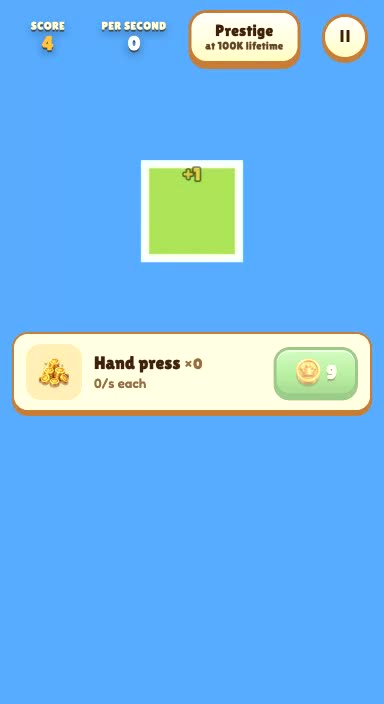
An idle clicker starts with tapping for currency, then lets the player buy generators that earn currency every second without tapping. Each generator costs more than the last, usually by a fixed multiplier, so progress slows until a new tier or a prestige reset speeds it up again. To make one, you need a tap action, a generator list with cost and income values, a save system that pays offline earnings, and a prestige loop.
- Template: Idle clicker
- Play an example: EvonX Factory
- Updated
A prompt to build your first version
Copy it into EvonX, or send it from the box at the end of this page. Change the theme, the numbers and the twist to make it yours.
Create an idle clicker game where I tap a bakery to earn coins, buy ovens, bakers and delivery vans that earn coins every second, each upgrade costs more than the last, I get earnings for the time I was away, and I can prestige to restart with a permanent bonus.
Other directions to try:
- An idle space mining clicker where drones and asteroid stations produce ore, with a prestige that moves me to a richer galaxy
- A cozy idle cafe clicker with cats as staff and a daily bonus
How idle clicker games work
Idle games are built around numbers that grow. The art and theme matter, but the experience is shaped almost entirely by a handful of formulas.
Tapping starts the economy
At the start, tapping is the only income. It gives the player something to do in the first minute and makes the first generator purchase feel earned.
Generators earn while you wait
Each generator has a base cost and an income per second. Owning more of one multiplies its income. Soon generators out-earn tapping by a wide margin, and the game shifts from action to decisions.
Costs grow exponentially
The usual formula is cost = base cost × growth rate ^ number owned, with growth around 1.07 to 1.15. Income grows linearly with the number owned, so each purchase gives less value than the last. That tension decides when to move to the next tier.
Offline earnings bring players back
When the player returns, pay the income for the time away, usually capped at a number of hours and sometimes at reduced efficiency. Showing that amount on return is one of the strongest moments in the genre.
Prestige resets with a bonus
Once progress slows, the player can reset everything in exchange for a permanent multiplier. The next run goes much faster, which turns a plateau into a fresh start.
Step by step: building an idle clicker
1. The tap
One large target in the middle of the screen, a coin counter, and a small animation and sound on each tap.
2. The first generator
Add one generator with a base cost, income per second and the cost formula. Tick income every second (or every frame, scaled by time).
3. A ladder of generators
Add tiers where each costs roughly ten times the previous and earns several times more. Hide or lock tiers until the player can nearly afford them.
4. Big number formatting
Numbers will pass the millions quickly. Format them as 1.2K, 3.4M, 5.6B and beyond, and use a number type that handles very large values if your engine needs it.
5. Saving and offline earnings
Save every few seconds and on exit, including a timestamp. On load, compute the time away, apply your cap, and show a welcome-back screen with the amount earned.
6. Upgrades
Add one-off upgrades that multiply a generator's output or the tap value. These give players a short-term goal between generator purchases.
7. Prestige
Unlock prestige after a lifetime-earnings threshold. Reset coins and generators, grant a permanent multiplier based on lifetime earnings, and make the next run visibly faster.
8. Tune with a spreadsheet
Plot time-to-next-purchase across a run. If any gap is far longer than the ones around it, players will hit a wall there. Adjust base costs or add an upgrade to bridge it.
Pacing an idle game
Idle games have no levels, so pacing is the time between meaningful purchases.
| Stage | What changes |
|---|---|
| First minutes | A purchase every few seconds. The player should own several generators before they think about leaving. |
| First session | Purchases slow to every minute or so; a new tier unlocks just as the previous one feels slow. |
| Return visits | Offline earnings buy a burst of upgrades, which is the reward for coming back. |
| Prestige point | The first prestige should become attractive within a session or two, not days. |
Build it with EvonX
1. Describe the game
Paste the prompt above or write your own. Naming the genre is enough for EvonX to start from its idle clicker template.
2. Play the first version
The game runs in a phone preview next to the chat, so you can play it as soon as it is built.
3. Change it in chat
Ask for different levels, rules, art or difficulty and test each change straight away.
4. Publish a link
Published games open in mobile and desktop browsers, on the free Starter plan too (with the EvonX badge). EvonX does not package games for the App Store or Google Play.
What the idle clicker template already includes
- A central money-maker that pays coins on every tap
- A ladder of producers with cost, cost growth, income rate and unlock threshold
- Producers that unlock as lifetime coins grow
- Offline earnings paid once on return, capped and at reduced efficiency
- Prestige: reset the run for a permanent production multiplier
- Autosave, a single portrait screen and tap controls
Ways to make it your own
- Theme and what the player taps: a bakery, a mine, a spaceship
- Number of generator tiers and their names
- Cost growth rate and income per tier
- Offline earnings cap and efficiency
- Prestige threshold and multiplier
- Upgrades, daily bonuses and achievements
Common problems and how to fix them
Progress hits a wall after a few minutes
Check the time-to-next-purchase curve. Add an upgrade or lower the next tier's base cost where the gap jumps.
Numbers overflow or show in scientific notation
Use a big-number format for display (K, M, B, T, then letter pairs) and a numeric type that can hold very large values.
Players lose progress
Autosave on a short interval and whenever the page is hidden or closed, not only on manual save.
Prestige feels like a punishment
Show the multiplier the player will get before they reset, and tune it so the next run reaches the previous peak noticeably faster.
FAQ
What is the difference between a clicker and an idle game?
A clicker rewards tapping; an idle game rewards waiting. Most modern games in the genre are both: tapping matters at the start, generators take over later.
What cost growth rate should I use?
Many idle games use a multiplier between about 1.07 and 1.15 per purchase. Lower values feel generous; higher values push players toward new tiers and prestige sooner.
Can I make an idle game without coding?
Yes. Describe the theme and generators to EvonX; it starts from the idle clicker template with tapping, producers, offline earnings and prestige already working, and you tune it in chat.
Do idle games need a server?
Not for a single-player game. Progress and offline earnings can be saved on the device; the EvonX template saves automatically.
Make your own idle clicker game
Start from the prompt, or describe something new. Building and playing in the preview are free.