Game creation guide
How to make a survivors-like game
A survivors-like (also called a bullet heaven or horde survival game) is a top-down game where the player only moves, weapons fire by themselves, and hundreds of enemies close in over a timed run. Kills drop experience; each level-up offers a choice of new weapons or upgrades. To make one, you need cheap enemy movement for large crowds, a level-up choice screen, and a spawn schedule that keeps the pressure rising until a boss.
- Template: Survivor arena
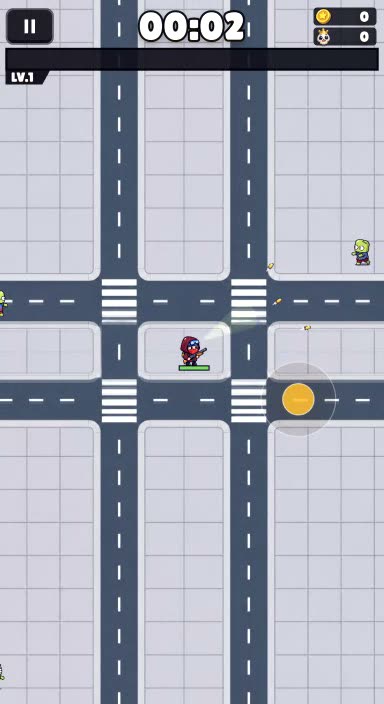
- Play an example: City Survivor
- Updated
A prompt to build your first version
Copy it into EvonX, or send it from the box at the end of this page. Change the theme, the numbers and the twist to make it yours.
Create a top-down survivor game in a cartoon city where I move with a joystick, my weapons fire automatically, zombies come from every side in growing waves, kills drop XP gems, every level-up lets me pick one of three upgrades, maxed weapons can evolve, and a boss arrives every few minutes.
Other directions to try:
- A fantasy survivors-like where a wizard holds off skeletons, with a fire ring, lightning chain and orbiting daggers as starting weapons
- A space survivors-like where a small ship fights alien swarms and collects energy crystals to level up
How survivors-like games work
The genre took off with Vampire Survivors and mobile games like Survivor.io. The rules are simple on purpose: the player has one control, so all of the depth is in the build they assemble during the run.
Movement is the only input
The player steers with a joystick or keys. Attacking is automatic, so the skill is positioning: kiting the crowd, threading gaps and collecting drops without getting surrounded.
Weapons run on independent cooldowns
Each weapon has its own pattern (a cone, a ring, a homing bolt, an orbiting blade) and fires on its own timer. Owning several weapons layers their patterns into the screen-filling effect the genre is known for.
Experience and the level-up choice
Kills drop gems. When the bar fills, the game pauses and offers three random cards: a new weapon, a level for an owned weapon, or a passive stat item. This choice, repeated dozens of times, is the core decision of the game.
Evolutions reward planning
A weapon at max level combined with a specific passive item can evolve into a much stronger version. Knowing the pairs gives returning players something to plan around.
The run is driven by a clock
Instead of levels with an end, a run lasts a set time. A spawn schedule raises enemy count and toughness over time, adds elites that drop chests, and stops the clock for boss fights.
Step by step: building a survivors-like
1. Player movement and camera
Move the player at a constant speed and keep the camera centered. Use an open map that repeats or generates in chunks so the player never hits a wall.
2. Enemies that chase cheaply
Each enemy steps toward the player every frame. With hundreds on screen, skip physics engines: use simple circle overlap checks and a spatial grid so each enemy only checks nearby neighbors.
3. One automatic weapon
Fire at the nearest enemy on a cooldown. Pool projectiles and enemies instead of creating and destroying objects, or the game will stutter as the crowd grows.
4. Experience drops and the level-up screen
Drop a gem on each kill, pull gems in when the player is within pickup range, and pause on level-up to show three cards. Weight the draw so players see upgrades for weapons they already own.
5. A spawn schedule
Write the run as phases on the clock: which enemies spawn, how many and how fast. Add an elite every minute or two and a boss at fixed times.
6. More weapons, passives and evolutions
Give each weapon several levels with clear jumps in power. Add passive items (speed, area, cooldown, pickup range) and define evolution pairs.
7. Meta progression
Between runs, let players spend earned currency on permanent bonuses or new characters. This is what brings players back after a failed run.
8. Readability pass
Give enemies, player projectiles and enemy projectiles clearly different colors and shapes. With this much on screen, readability is a gameplay feature.
Pacing a run
Survivors-likes are tuned by the clock. The player should feel weak early, powerful in the middle, and under real pressure near each boss.
| Stage | What changes |
|---|---|
| First minute | Slow, sparse enemies. The first level-ups come quickly so the player starts building right away. |
| Minutes 2–5 | Faster enemies and packs, the first elite and chest, and the first boss in a closed arena. |
| Mid run | Crowds big enough to need area weapons, enemies that sweep across the screen, ranged attackers. |
| Final boss | The last boss tests the full build; beating it completes the chapter. |
Build it with EvonX
1. Describe the game
Paste the prompt above or write your own. Naming the genre is enough for EvonX to start from its survivor arena template.
2. Play the first version
The game runs in a phone preview next to the chat, so you can play it as soon as it is built.
3. Change it in chat
Ask for different levels, rules, art or difficulty and test each change straight away.
4. Publish a link
Published games open in mobile and desktop browsers, on the free Starter plan too (with the EvonX badge). EvonX does not package games for the App Store or Google Play.
What the survivor arena template already includes
- A floating joystick (or WASD) to move; every owned weapon fires on its own cooldown
- A run on a clock, with the horde thickening phase by phase on an open, endless map
- Experience gems from kills and a three-card skill choice on every level-up
- Weapons up to five stars, supply items, and evolutions when a maxed weapon meets its partner supply
- Elite enemies that drop a chest, and a boss fight inside a closing cage
- 10 starter chapters, a talent tree bought with gold and a daily reward ladder
Ways to make it your own
- The setting and hero: city, dungeon, space
- Starting weapon and the weapon list
- Enemy types, crowd size and boss behavior
- Run length and when bosses appear
- Evolution pairs and passive items
- Meta upgrades between runs
Common problems and how to fix them
Frame rate drops when the horde gets big
Pool enemies and projectiles, use a spatial grid for collisions instead of a physics engine, and cap particles. Draw only what the camera sees.
Level-up choices feel random and useless
Weight the card draw toward weapons the player owns and away from maxed items, and guarantee at least one useful card in each hand.
The middle of a run is boring
Add events on the clock: elites with chests, a ring of enemies that closes in, a line of enemies sweeping across, or a mini-boss.
Players cannot see what is hitting them
Give enemy projectiles a strong contrasting color and make the player's own effects slightly transparent.
FAQ
Can I make a game like Vampire Survivors?
You can make a game in the same genre. Auto-firing weapons and level-up choices are shared by many games. Use your own characters, weapons, art and name rather than copying another game's assets.
Does a survivors-like work on mobile?
Yes. The genre suits phones because it only needs one thumb. EvonX's survivor template uses a floating joystick in portrait.
How many weapons does a survivors-like need?
Enough that two runs feel different. A starter build can work with a handful of weapons and passives; the EvonX template starts with a much larger arsenal you can trim or extend in chat.
Can I change the weapons in the EvonX template?
Yes. Ask in chat to add, remove or rebalance a weapon, change an evolution, or reskin the whole arsenal to a new theme.
Make your own survivor arena game
Start from the prompt, or describe something new. Building and playing in the preview are free.