Game creation guide
How to make an idle tycoon game
An idle tycoon is a business that runs itself: workers produce goods at stations, something carries the goods to where they are sold, and the player spends the income on upgrades. The interesting decisions come from the chain. One part is always the bottleneck, so the player keeps choosing which station to upgrade next, hires managers to automate it, and eventually moves to a new location that earns more.
- Template: Idle tycoon
- Play an example: Deep Dig Tycoon
- Updated
A prompt to build your first version
Copy it into EvonX, or send it from the box at the end of this page. Change the theme, the numbers and the twist to make it yours.
Create an idle tycoon game about a pizza restaurant where cooks make pizzas at ovens, a waiter carries them to the counter, the counter is the bottleneck, I can upgrade every station, hire managers so it runs without me, collect earnings while I was away, and open a bigger restaurant for a multiplier.
Other directions to try:
- An idle mining tycoon with coal, copper and gold shafts, a lift that hauls ore up, and managers for each shaft
- An idle hotel tycoon where rooms earn money, cleaners and receptionists are the chain, and new hotels unlock in bigger cities
How idle tycoon games work
Tycoons share the exponential math of clickers, but add a physical production chain. That chain is what gives the player a reason to look at the screen.
Stations produce on a cycle
Each station (a shaft, an oven, a checkout) has a worker who completes a cycle and adds goods to a buffer. Upgrading the station raises output per cycle or shortens the cycle.
A carrier links the stations
Something moves goods from the stations to where money is made: a lift, a conveyor, a waiter. It has a capacity and a trip time, so it can only carry so much per minute.
The bottleneck is the game
If the carrier is slower than the stations, goods pile up; if the stations are slower, the carrier waits. The player's main decision is spotting the slowest link and upgrading it, which moves the bottleneck somewhere else.
Managers automate
At first the player taps to start each cycle. Hiring a manager makes a station run on its own, which is what turns an active game into an idle one and makes offline earnings possible.
New locations are the prestige
Instead of a plain reset, the player moves to a new mine, restaurant or city that starts empty but earns with a higher multiplier. It feels like expansion rather than starting over.
Step by step: building an idle tycoon
1. One station and one worker
Animate a worker walking to the station, working and returning with goods to a buffer. Define cycle time and output per cycle.
2. The carrier and the sale point
Add a carrier with capacity and trip time that collects from the buffer and pays at the sale point. Show the cash total updating when it arrives.
3. More stations on slots
Add empty slots the player can buy. Each new station produces a more valuable good, so expanding competes with upgrading.
4. Upgrades with exponential costs
Each station and the carrier get levels. Use a cost multiplier per level and add milestone levels that give a bigger jump in output.
5. Show the bottleneck
Make piled-up goods visible on screen and show each station's throughput next to the carrier's. Players should see the bottleneck rather than calculate it.
6. Managers and offline earnings
Let the player hire a manager per station. When every link is managed, compute offline earnings from the chain's slowest throughput times the time away, with a cap.
7. New locations
Unlock the next location after a lifetime-earnings target. Each location keeps the same rules with a higher multiplier and new art.
8. Session hooks
Daily rewards, timed boosts and short events give players a reason to open the game between long idle periods.
Pacing a tycoon
As with clickers, pacing is the time between meaningful decisions, but the chain adds a second rhythm: the bottleneck moving.
| Stage | What changes |
|---|---|
| First minutes | One station, tap to work, an upgrade every few seconds. The first manager is affordable early. |
| Expansion | New stations unlock one by one; the carrier becomes the bottleneck and the player learns to upgrade it. |
| Automation | Managers for every link; offline earnings become meaningful. |
| New location | Moving on should be clearly better than staying, both in income and in fresh things to unlock. |
Build it with EvonX
1. Describe the game
Paste the prompt above or write your own. Naming the genre is enough for EvonX to start from its idle tycoon template.
2. Play the first version
The game runs in a phone preview next to the chat, so you can play it as soon as it is built.
3. Change it in chat
Ask for different levels, rules, art or difficulty and test each change straight away.
4. Publish a link
Published games open in mobile and desktop browsers, on the free Starter plan too (with the EvonX badge). EvonX does not package games for the App Store or Google Play.
What the idle tycoon template already includes
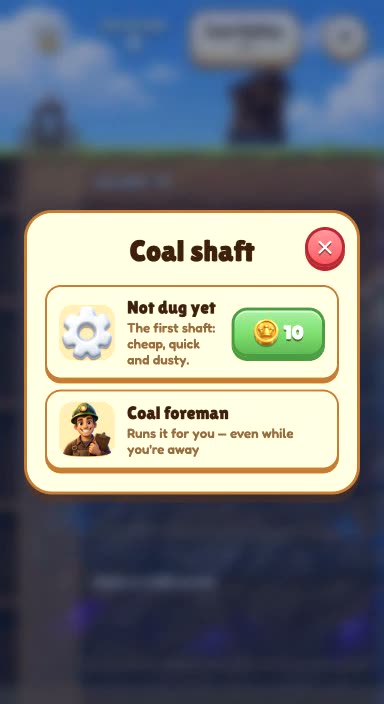
- A mine built shaft by shaft down a mountain, each worked by a miner on a cycle
- A lift that collects from every shaft and pays at the surface, and is the bottleneck
- Shaft and lift upgrades, and managers that run a station without taps
- Earnings collected while the player was away
- A ladder of richer mines, each with a multiplier, as the prestige loop
- Daily rewards and events
Ways to make it your own
- The business: mine, restaurant, factory, hotel, farm
- Number of stations and what each produces
- The carrier: lift, conveyor, trucks, waiters
- Upgrade costs, milestones and managers
- Locations and their multipliers
- Art style and setting, from one sentence
Common problems and how to fix them
Players do not understand what to upgrade
Make the bottleneck visible: piles of goods at stations, an idle carrier, or a throughput number next to each link.
Offline earnings are far too high or too low
Compute them from the slowest link in the chain, not the sum of all stations, and apply a cap on hours away.
The game becomes a waiting room
Add short-term goals between big purchases: milestone upgrades, timed boosts, daily rewards or a new location within reach.
Workers walking around slows phones down
Keep worker animations simple, pool sprites, and stop animating stations that are off screen.
FAQ
What is the difference between an idle clicker and an idle tycoon?
A clicker is a list of generators. A tycoon puts them in a visible production chain with a carrier, so the player manages a bottleneck instead of only buying the next tier.
Can I make a game like Idle Miner Tycoon?
You can make an idle mining tycoon; shafts, lifts and managers are common genre mechanics. Use your own name, characters and art rather than another game's assets.
Can I change the theme from a mine to something else?
Yes. Describe your business in the prompt (a pizzeria, a factory, a hotel) and EvonX adapts the stations, carrier and art. You can keep changing it in chat.
Is a tycoon game good for mobile?
Yes. Short check-ins and offline earnings fit how people use phones. EvonX tycoon games run in portrait with tap controls in any mobile browser.
Make your own idle tycoon game
Start from the prompt, or describe something new. Building and playing in the preview are free.