Game creation guide
How to make an endless runner game
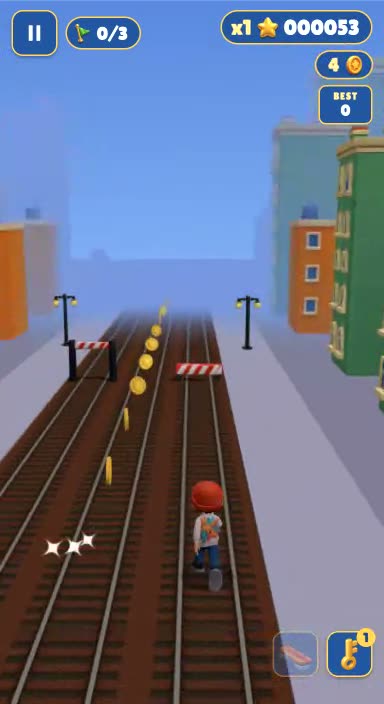
An endless runner moves the player forward automatically while obstacles come at them; the player only dodges. Modern 3D runners use three lanes with swipe controls: left and right to change lanes, up to jump, down to roll. The track is built from short pre-made chunks picked by difficulty, the speed rises with distance, and coins, power-ups and missions keep each run interesting.
- Template: Endless runner
- Play an example: Rail Rush
- Updated
A prompt to build your first version
Copy it into EvonX, or send it from the box at the end of this page. Change the theme, the numbers and the twist to make it yours.
Create a 3D endless runner on three lanes where I swipe left and right to change lanes, swipe up to jump and down to roll, trains and barriers block the lanes, coins line the track, power-ups include a magnet and a jetpack, the run speeds up over time, and the score is distance plus coins.
Other directions to try:
- A jungle temple runner on three lanes with fallen logs to jump, vines to slide under and a monkey chasing me
- A neon cyber city runner on hoverboards with drones as obstacles and a shield power-up
How endless runners work
Games like Temple Run and Subway Surfers made the three-lane runner a mobile staple. The design works because it strips control down to four swipes and makes every second a quick decision.
Forward motion is automatic
The game moves the runner. The player never controls speed, only position, which keeps the input simple enough for one thumb.
Lanes make dodging readable
Three discrete lanes mean an obstacle is either in your lane or not. A swipe snaps the runner exactly one lane over, so mistakes are clear and fair.
Each obstacle asks for one verb
Low barriers ask for a jump, high barriers for a roll, and full blockers such as trains for a lane change. Mixing them in quick succession is where the challenge comes from.
The track is assembled from chunks
Instead of placing random obstacles, runners stitch together short hand-made or generated sections. Each chunk is guaranteed to have a way through, and chunks are grouped by difficulty.
Meta systems give runs a purpose
Coins buy characters and boards, missions raise a score multiplier, and power-ups create short bursts of a different kind of play. Without them, runs blur together.
Step by step: building an endless runner
1. The runner and the lanes
Keep the runner at a fixed point on screen and move the world toward it, or move the runner and the camera together. Define three lane positions and snap between them over a short duration.
2. Swipe input
Detect swipes by distance and direction, with a small threshold so taps do not trigger moves. Map arrow keys as well for desktop testing.
3. Jump and roll
A jump is a timed arc; a roll is a timed low pose. Treat each as a state that lasts a fixed time, and check obstacles against the current state.
4. Chunks and pooling
Build the track from chunks, each a few rows long with an obstacle or coin per lane per row. Spawn chunks ahead, recycle them behind, and reuse objects instead of creating new ones.
5. Prove every chunk is passable
Run a simple solver over each chunk to confirm a path exists given the lane change, jump and roll timings at the speed it will appear. Discard chunks that fail.
6. Speed ramp and difficulty bands
Increase speed gradually with distance up to a maximum. Switch the chunk pool to harder bands at set distances.
7. Hits and second chances
A glancing hit can cause a stumble rather than an instant loss; a second hit ends the run. A collectible key or a paid revive lets the player continue once.
8. Coins, power-ups and missions
Place coin lines that hint at safe paths, add a few timed power-ups, and give the player missions that raise their score multiplier across runs.
Difficulty over a run
Endless runners have no levels. Difficulty is a function of distance.
| Stage | What changes |
|---|---|
| Opening | Slow speed, single obstacles with long gaps, lots of coins. The player learns each verb. |
| Middle | Faster speed, combinations such as a jump then a lane change, trains that force planning ahead. |
| Late run | Near top speed, dense chunks from the hardest band, fewer safe lanes. |
| Fairness rule | Never generate a section the player cannot react to at the current speed; the solver check enforces this. |
Build it with EvonX
1. Describe the game
Paste the prompt above or write your own. Naming the genre is enough for EvonX to start from its endless runner template.
2. Play the first version
The game runs in a phone preview next to the chat, so you can play it as soon as it is built.
3. Change it in chat
Ask for different levels, rules, art or difficulty and test each change straight away.
4. Publish a link
Published games open in mobile and desktop browsers, on the free Starter plan too (with the EvonX badge). EvonX does not package games for the App Store or Google Play.
What the endless runner template already includes
- A 3D run on three lanes with the camera behind and above the runner
- Swipe or arrow keys: change lane, jump low barriers, roll under high ones
- Trains to dodge or run along, with ramps onto the roofs
- A track built from chunks in three difficulty bands, each with a proven path
- Speed that ramps with distance; magnet, coin doubler, jetpack and super sneakers
- A stumble on a light hit, a second-chance key, a hoverboard shield
- Missions that raise the score multiplier, mystery boxes and a garage of characters and boards
Ways to make it your own
- Setting and character: train yard, temple, city rooftops, space
- Number of lanes and obstacle types
- Starting speed, top speed and ramp rate
- Power-ups and how long they last
- Characters and boards for sale in the garage
- Missions and score multiplier rules
Common problems and how to fix them
Some sections are impossible to pass
Build the track from chunks and verify each chunk with a solver at the speed it will be used. Do not place obstacles one at a time at random.
Swipes are missed or misread
Use a distance threshold rather than speed, decide the direction from the larger axis, and buffer one input so a swipe made just before a lane change finishes still counts.
The game stutters after a minute
Pool chunks, coins and obstacles. Creating and destroying objects every second causes garbage collection pauses on phones.
Runs feel the same every time
Add missions, rotating power-ups and rare chunks such as train roofs or ramps that change how the player moves.
FAQ
Can I make a game like Subway Surfers or Temple Run?
You can make a three-lane endless runner; lane switching, jumping and rolling are common genre mechanics. Create your own characters, world and name rather than reusing another game's assets.
Does an endless runner need levels?
No. Most endless runners have one infinite run where difficulty rises with distance. The EvonX template works this way and saves the best score.
Is the EvonX runner 2D or 3D?
The endless runner template is drawn in 3D with the camera behind the runner. You can ask in chat to change the setting, obstacles and characters.
Can I play it on desktop too?
Yes. Swipes on phones, arrow keys on desktop. Published EvonX games open in mobile and desktop browsers.
Make your own endless runner game
Start from the prompt, or describe something new. Building and playing in the preview are free.