Product · Automated Testing
Every step tested as it's built — not after.
Evonx splits each change into action nodes and verifies every node before moving to the next. By the time you see the work, it has already survived its own test suite.
A test after every step
Each step of the plan is an action node with its own verification. The agent doesn't build on top of a step until that step is proven to work.
Failures fixed before you see them
When a check fails, the agent diagnoses and repairs it as part of the same step — you review working software, not a list of broken attempts.
Verified in a real environment
Tests run in the live preview environment — a real container with a real database — not against mocks that pass while production breaks.
Regressions caught before the PR
Because verification happens continuously during the build, regressions surface while they're one step deep — not after they're buried under a week of changes.
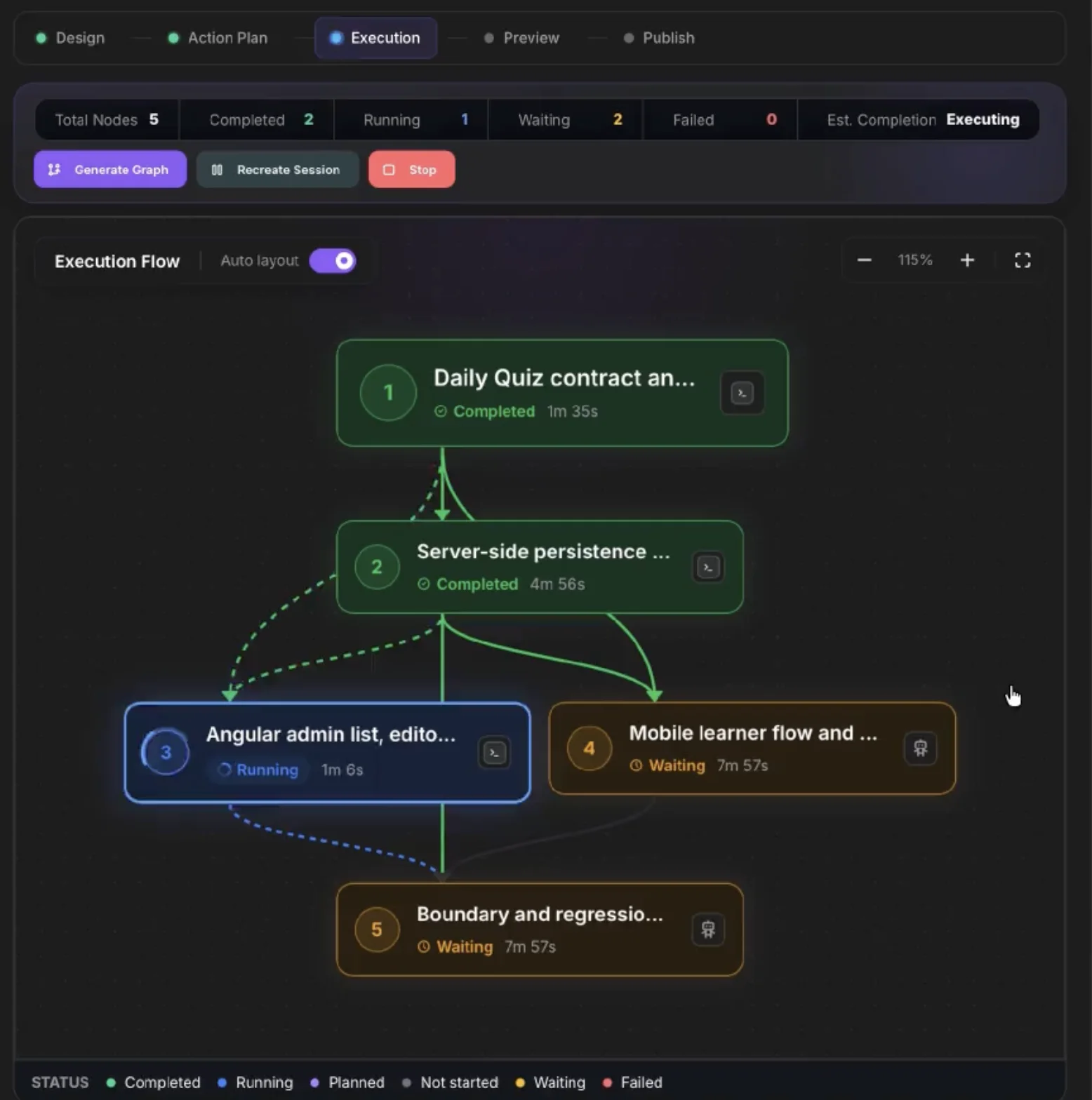
What the execution graph shows
A run is a graph of action nodes, and the arrows are real dependencies rather than a to-do order. Here the data model and the persistence layer are green, which is what released the admin screens to start building; the mobile flow behind them is queued, and the bottom node — boundary and regression tests — stays amber until both branches land, because until then there is nothing meaningful to regress against. The counters across the top are the run in one line: how many nodes exist, how many are done, how many are in flight, and how many have failed.
Testing as part of building, not a phase after it
In most teams, testing is a stage that starts when development ends — which is exactly when defects are most expensive to unwind. Evonx inverts that: verification is wired into every action node, so quality is enforced step by step while the change is still cheap to correct.
Proof, then approval
The result of a tested build is a running live preview you can click through yourself. You approve based on working software and passing checks — and only then does the change become a pull request in your repository.
Ship changes that arrive already tested.
Start free. Describe a change and watch each step build, test, and verify itself in front of you.