Game creation guide
How to make a parking jam game
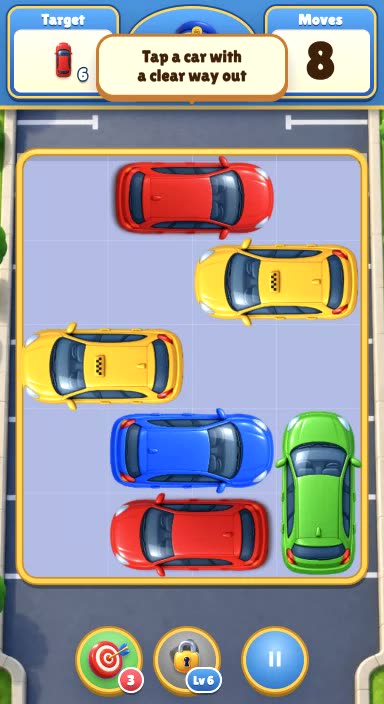
A parking jam game is a grid of parked cars, each facing one way. Tapping a car drives it straight out if its lane is clear; if something is in the way it bumps and the tap is wasted. To make one you need three things: a grid model where every car knows its heading and length, a rule that checks the lane before moving, and levels that are proven solvable within a move budget.
- Template: Parking jam
- Play an example: Parking Rush
- Updated
A prompt to build your first version
Copy it into EvonX, or send it from the box at the end of this page. Change the theme, the numbers and the twist to make it yours.
Create a colorful parking jam puzzle game with tap controls, 20 levels that get harder, cars and vans that bump when their lane is blocked, a move counter, traffic cones as obstacles, a level complete screen and portrait mobile controls.
Other directions to try:
- A night-time parking jam with neon taxis, where a locked car only leaves after three other cars are out
- A parking jam on a ferry deck: every vehicle has to drive off the ramp side before the boat leaves
How parking jam games work
Under the cars, a parking jam is a grid puzzle. Each vehicle occupies a straight run of cells and can only travel along its own heading, so the whole game is about the order in which lanes open up.
Vehicles are runs of cells with a heading
Store each car as its front cell, its length (two cells for a car, three for a van) and one of four directions. Turning the sprite to match the heading is purely visual; the rules only care about cells.
A tap checks the whole lane, not the next cell
When the player taps, walk every cell from the car's nose to the edge of the lot in its heading. If all are empty, the car drives out and its cells are freed. If any cell is taken, the car moves up to the blocker, bumps it and slides back.
Bumps cost a move
Most versions count every tap, successful or not. That is what turns random tapping into planning: the move budget punishes guessing, and the bump animation tells the player which car is in the way.
Win and lose conditions are simple
The level is won when the lot is empty. It is lost when the move counter reaches zero with cars still parked. A one-time offer of extra moves at the last tap softens the loss without removing it.
Obstacles change the order, not the rules
A cone occupies a cell until the player spends a move removing it. A chained car carries a number and only unlocks after that many other cars have left. Both force a different solving order without new controls.
Step by step: building a parking jam from scratch
These steps apply whether you code it yourself in any engine or generate it with AI. The order matters: get the grid right before the art.
1. Model the lot as a grid
Pick a grid size that reads on a phone in portrait, such as 6×8 to 8×10 cells. Keep an occupancy map from cell to vehicle id so a lane check is a loop over integers, not a physics query.
2. Add vehicles with heading and length
Each vehicle needs an id, front cell, length, heading and color. Validate at load time that no two vehicles overlap and every vehicle sits fully inside the lot.
3. Write the lane check and the exit
On tap, step from the nose toward the edge. Clear lane: free the cells, animate the drive-out and count the car. Blocked lane: animate a short move to the first blocker, a bump, and a return. Spend a move either way.
4. Add the move budget and level end
Show remaining moves in the HUD. Empty lot wins and awards stars by moves left; zero moves loses. Decide whether you offer extra moves once before the loss screen.
5. Generate levels backwards
The easiest way to guarantee a solvable level is to build it in reverse: start from an empty lot and drive cars in from the edges along their headings until the lot is full. The reverse order is a known solution, and its length sets the minimum move count.
6. Set the budget from the solution
Give the player the solution length plus some slack. Early levels get generous slack; hard levels get little. This is the main difficulty dial, more than the grid size.
7. Layer obstacles and boosters
Introduce one new element at a time, each with a short intro the first time it appears. Typical order: a hint booster first, then cones, then a tow booster that removes any car, then chained cars.
8. Polish the feedback
Short drive-out and bump animations (well under half a second), a sound for each, and particles when a car leaves. In this genre, feedback is most of what makes it feel satisfying.
Level design and difficulty
Difficulty in a parking jam comes from dependency chains, meaning how many cars must leave before a given car can move, more than from the number of cars.
| Stage | What changes |
|---|---|
| Levels 1–3 | Six to ten cars, most with a clear lane on the first tap, generous moves. The player learns that direction matters. |
| Levels 4–10 | Longer dependency chains, vans that block two lanes at once, cones introduced. Moves are the solution plus a modest margin. |
| Every 5th level | A hard level: a tight budget and one key car buried in the middle of the lot. |
| Every 10th level | A super-hard level that combines chained cars with cones and almost no spare moves. |
Build it with EvonX
1. Describe the game
Paste the prompt above or write your own. Naming the genre is enough for EvonX to start from its parking jam template.
2. Play the first version
The game runs in a phone preview next to the chat, so you can play it as soon as it is built.
3. Change it in chat
Ask for different levels, rules, art or difficulty and test each change straight away.
4. Publish a link
Published games open in mobile and desktop browsers, on the free Starter plan too (with the EvonX badge). EvonX does not package games for the App Store or Google Play.
What the parking jam template already includes
- A lot of two-cell cars and three-cell vans, each turned to its heading
- Tap to drive out, or bump and back up when blocked (a move spent)
- A move budget with a one-time offer of extra moves
- Cones that cost a move to clear and chained cars that unlock after N cars leave
- Hint, tow and extra-moves boosters unlocking on a schedule
- 20 starter levels with a hard level every 5 and a super-hard every 10
Ways to make it your own
- Swap the setting: an airport apron, a ferry deck, a toy car mat
- Change vehicle lengths, for example add four-cell buses
- Tighten or loosen the move budget on hard levels
- Add a timer instead of a move budget for a different feel
- Introduce a new obstacle with its own unlock level
- Reskin the whole game with one sentence in chat
Common problems and how to fix them
Some generated levels cannot be solved
Generate levels by reverse play (driving cars in from the edges) so every level ships with a known solution, or run a solver over each layout before keeping it.
Levels feel random rather than clever
Measure the longest dependency chain in each level and make it grow across the level list. A level where every car can leave on the first tap has no puzzle in it.
Players cannot tell which way a car is facing
Draw cars from directly above with a clear front (headlights, windshield) and keep the art turned to the heading. Avoid near-symmetrical vehicle sprites.
Taps feel sluggish on mobile
Keep each animation short, accept the next tap while the previous car is still driving out, and resolve the grid state immediately rather than at the end of the animation.
FAQ
Do I need to know how to code to make a parking jam game?
No. You can build one in any engine if you code, but with EvonX you describe the game in a sentence, it starts from the parking jam template, and you change levels, obstacles and art by asking in chat.
How many levels should a parking jam game have?
Enough to introduce every obstacle and booster with room to practice each. The EvonX template starts with 20, and you can ask for more levels at any point.
Is it legal to make a game like Parking Jam 3D?
Game mechanics such as sliding cars out of a grid are widely used across many games. What you should not copy is another game's name, art, logos or level files. Build your own setting, art and levels.
Can people play my parking jam game on their phones?
Yes. EvonX games are web games in portrait with tap controls, so a published link opens in mobile and desktop browsers. EvonX does not package games for the App Store or Google Play.
Make your own parking jam game
Start from the prompt, or describe something new. Building and playing in the preview are free.