Game creation guide
How to make a block puzzle game
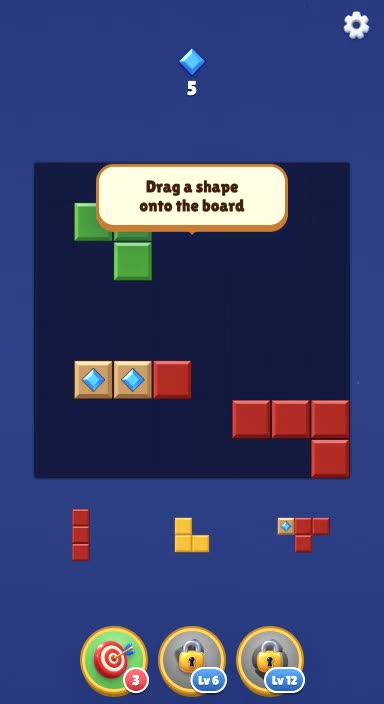
In a modern block puzzle, the player drags shapes from a rack of three onto a grid (usually 8×8). A full row or column clears, nothing falls, and a new set of three arrives once all three are placed. The game ends when none of the shapes fits. The key design work is in the piece deal: random shapes that are fair, so a loss feels like the player's mistake rather than bad luck.
A prompt to build your first version
Copy it into EvonX, or send it from the box at the end of this page. Change the theme, the numbers and the twist to make it yours.
Create a block puzzle game on an 8x8 grid where I drag one of three shapes onto the board, full rows and columns clear, consecutive clears build a combo, three new shapes arrive when the rack is empty, the game ends when nothing fits, and levels ask for a target score or gems.
Other directions to try:
- A wooden block puzzle with a calm theme, a daily challenge board and no timer
- A jewel block puzzle where gem blocks fly to a counter when their line clears and each level asks for a number of gems
How block puzzle games work
Block puzzles borrow the line clear from falling-block games but remove gravity and time pressure. That makes them a game of space management: every placement either opens room or quietly closes it.
Shapes come in sets of three
The rack shows three shapes at once, and new ones only arrive when all three are placed. The player can choose the order, so the decision is which shape goes where and in what sequence.
Rows and columns clear, nothing falls
When a row or column has no free cell, it clears. The rest of the board stays exactly where it is. Clearing a row and a column at once with a single placement is the big satisfying moment.
Combos reward clearing in a streak
Consecutive placements that each clear at least one line build a combo multiplier. This pushes players to set up several lines at once instead of clearing one at a time.
The loss is a full rack
The game ends when none of the remaining shapes fits anywhere on the board. There is no timer, so the tension comes entirely from available space.
Level goals add a target
Endless mode chases a high score. A level mode can ask for a target score or for special blocks to be cleared, sometimes on a board that starts partly filled or with obstacles.
Step by step: building a block puzzle
1. Grid and shape library
Store the board as an 8×8 array of empty or filled cells. Define shapes as lists of cell offsets: single, lines of two to five, squares, L shapes, T shapes and corners.
2. Drag, preview and drop
While dragging, snap the shape to the nearest grid position and show a ghost. Highlight any line that would clear. On release, place it only if every cell is free; otherwise return it to the rack.
3. Clear full lines
After each placement, collect every full row and column first, then clear them together. Clearing as you find them breaks the row-and-column double clear.
4. Refill the rack and check for game over
When all three shapes are placed, deal three more. After every placement, test each remaining shape at every position; if none fits, end the game.
5. Make the deal fair
Pure random deals can hand a player three impossible shapes. A common fix is to guarantee that at least one shape in each new set fits the current board.
6. Scoring and combos
Score per cell placed, a bonus per line, and a multiplier for multi-line clears and streaks. Show the score popping where the clear happened.
7. Level goals and obstacles
For a level mode, start some boards partly filled, add cells that need two clears, or blocks that hold a cell. Give each level a score or collection target.
8. Feel
Most of the appeal is tactile: crisp snapping, a short burst on each clear, and a bigger effect for combos. Keep animations short so the next drag is never delayed.
Level design and difficulty
Difficulty comes from the starting board, the shape pool and the target, not from speed.
| Stage | What changes |
|---|---|
| Early levels | An empty or nearly empty board, small shapes, and a low target. |
| Middle levels | Boards that start with scattered blocks, larger shapes in the pool, and a target that needs combos. |
| Obstacle levels | Cells covered by ice that need clearing, or stones that cannot be filled. |
| Fairness check | Before keeping a level, simulate a simple player to make sure the target can actually be reached. |
Build it with EvonX
1. Describe the game
Paste the prompt above or write your own. Naming the genre is enough for EvonX to start from its block fit template.
2. Play the first version
The game runs in a phone preview next to the chat, so you can play it as soon as it is built.
3. Change it in chat
Ask for different levels, rules, art or difficulty and test each change straight away.
4. Publish a link
Published games open in mobile and desktop browsers, on the free Starter plan too (with the EvonX badge). EvonX does not package games for the App Store or Google Play.
What the block fit template already includes
- An 8×8 board with no gravity and a rack of three shapes
- Drag-to-place with a ghost preview and a highlight on lines about to clear
- Rows and columns that break when full while everything else stays put
- Combo streaks for consecutive clears
- Score or gem-collection goals per level
- Ice under cells and stones on cells as obstacles; hint, hammer and shuffle boosters
- 20 starter levels, each with a target the level generator has proven reachable
Ways to make it your own
- Grid size, for example 9×9 or 10×10
- The shape pool, including whether shapes can rotate
- Endless high-score mode versus level goals
- Obstacles and boosters
- Theme: wood, jewels, neon, candy
- Combo rules and scoring
Common problems and how to fix them
Players lose to impossible deals
Guarantee that at least one shape in every new rack fits the current board, and bias the pool toward smaller shapes when the board is crowded.
Rows and columns do not clear together
Find all full lines first, then clear them in one step. Clearing a row before checking columns empties cells the column needed.
Dragging feels off on a phone
Lift the dragged shape above the finger so it is visible, and snap it to the grid cell under the shape's center, not under the touch point.
Endless mode never ends
Gradually raise the share of large shapes in the pool as the score grows, so space becomes scarcer over time.
FAQ
Can I make a game like Block Blast?
You can make an 8×8 block puzzle with the same kind of rules, which are shared by many games. Give it your own name, theme and art, and do not reuse another game's assets.
How is a block puzzle different from a falling-block game?
There is no gravity and no timer. Shapes are placed anywhere they fit, and the challenge is managing space rather than speed.
Can shapes rotate?
Most mobile block puzzles do not rotate shapes, which keeps the decision simple. You can ask EvonX to add rotation if you want a different feel.
Can I add an endless mode?
Yes. The EvonX template uses level goals, and you can ask in chat for an endless high-score mode alongside or instead of levels.
Make your own block fit game
Start from the prompt, or describe something new. Building and playing in the preview are free.