
The distance between a concept and real customer feedback is mostly self-inflicted.
Generation speed helps, but it is not what decides whether an MVP takes two weeks or two months. Teams that ship quickly are not typing faster. They made a smaller number of decisions, earlier, and then refused to reopen them. That is a scoping discipline, and it is learnable.
Cut until one job remains
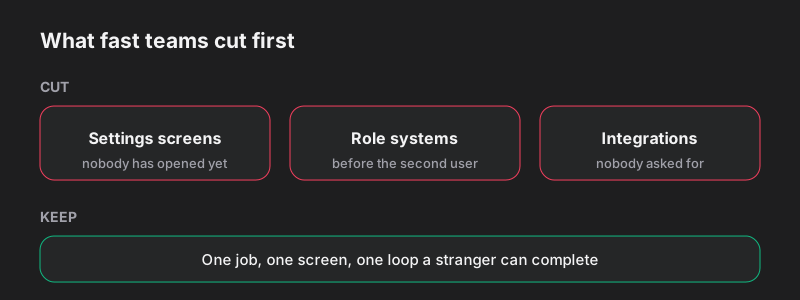
The reliable test: can a stranger complete one useful task without you sitting next to them? Everything not on the path to that is deferrable, including things that feel like table stakes.
Settings screens are the classic example. They feel like a requirement and are almost always premature — nobody configures a product they have not yet decided to use. Role and permission systems are the same story: real before the tenth user, imaginary before the second. Integrations are worth building when a specific person has asked for a specific one, and not before.
What survives the cut is narrow on purpose. One job. One screen where that job happens. One loop a real person can complete end to end.
A shape that tends to work
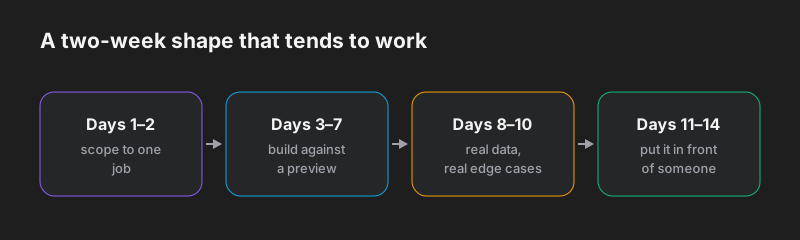
The first days are scoping, and they are the ones most often skipped. Writing down the single job — and the list of things explicitly not in scope — is what prevents the slow expansion that turns two weeks into two months.
The middle stretch is build, done against a running preview rather than a growing branch. Working this way means you are reviewing a product the whole time instead of a diff, which catches the "this is technically what I asked for" problem while it is still cheap.
Then real data. Not seed fixtures — the ugly export with inconsistent dates and a customer name in the wrong column. This is where MVPs actually break, and finding out during week two is very different from finding out in front of a user.
The last days are reserved for putting it in front of someone. Reserved, not "whatever is left over". Teams that treat this as slack time consistently do not get there.
Habits that make the difference
- Write the "not doing" list. An explicit exclusion list is easier to defend than an implicit one, and it makes scope creep visible as it happens.
- Keep one outcome per thread. Two goals in one thread means neither gets reviewed properly.
- Correct in plain language. "Overdue ones should be first" is a better instruction than a suggested implementation — and anyone on the team can write it.
- Show it before it is ready. The feedback that changes your direction almost never arrives from a polished demo.
The failure mode to watch for
The most common way a two-week MVP becomes a two-month one is not a hard technical problem. It is a sequence of small, individually reasonable additions — a second user type, an export button someone mentioned, a settings page because the export needed a default. None of them takes long. Together they move the finish line every few days, and because each step was justified, nobody notices the pattern until the calendar does.
The defence is procedural rather than heroic: when something new comes up, it goes on the exclusion list with a note about who asked for it, and it gets revisited after the first real user has been through the product. Most of those items quietly stop mattering once you have actual evidence about what people do.
Why speed compounds
The point of a fast MVP is not that it saves a few weeks. It is that it moves the learning earlier. A product put in front of a real user in week two starts its second version from evidence; one that appears in month three starts from the same assumptions it began with, having spent the interval getting more expensive to change.
Tooling can shorten the build. Deciding what not to build is still the part that decides the timeline.