
Preview hubs give every idea a place to run.
The alternative most teams live with is a shared staging environment: one box, one branch at a time, and a queue. Staging works until two people need it at once, which is roughly always. Then it becomes a scheduling problem, and the natural response — "I'll just test it in production, it's a small change" — is how small changes become incidents.
Isolation is the whole idea
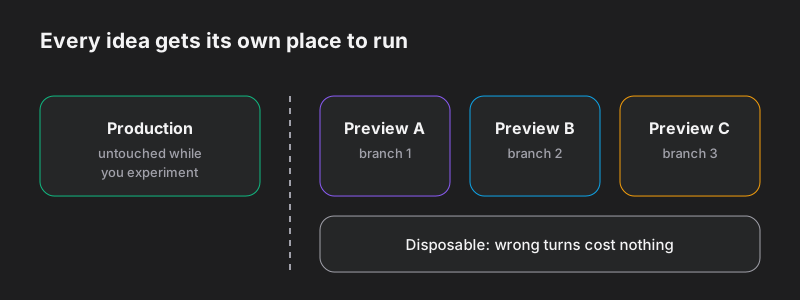
Every change gets its own environment. Not a slot in a queue — its own runtime, its own data, its own URL. Three people can be validating three different ideas at the same time without coordinating, and none of them can break the others or production.
The second-order effect matters more than the convenience. When an environment is disposable, you stop being careful with it. You try the version you are not sure about. You let the agent take an approach you suspect is wrong, because finding out costs a few minutes instead of a rollback. Cheap experiments change which experiments you are willing to run.
Reviewing a running thing, not a diff
Code review answers "is this implemented well?" It does not answer "is this right?" — and when an agent is writing the code, the second question is the one that carries the risk. A change can be clean, typed, tested, and still not the thing you asked for.
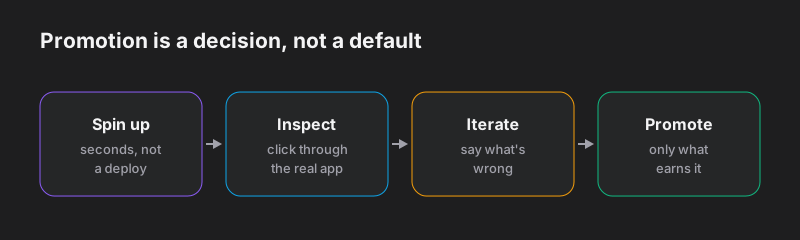
A preview turns review into something a non-engineer can do. The person who actually understands the workflow clicks through it and says what is wrong, in their own words. That feedback goes back into the evolution thread and becomes the next step. No translation layer between the person with the domain knowledge and the change.
What "safer" actually means here
Safety in this context is not one guarantee but several small ones:
- Blast radius. A preview cannot reach production data or production users. The worst outcome of a bad change is a broken preview.
- Reversibility. Nothing is promoted implicitly. A preview that does not earn its place is discarded, and discarding it costs nothing.
- Reproducibility. The environment is built from the change itself, so "works on my machine" is not a category that exists.
- Parallelism. No shared mutable environment means no one is ever blocked on someone else's half-finished test.
The cost that had to come down first
None of this works if a preview is expensive. When spinning one up takes ten minutes, people batch their changes to avoid paying the cost twice, and batching is exactly what destroys reviewability — you end up back at the large diff you were trying to avoid. The economics decide the workflow, not the other way round.
So the unglamorous engineering matters more than the feature list: how fast the environment starts, whether dependencies are cached between runs, whether a preview that failed to boot tells you why in a form you can act on. Every second removed there changes what people are willing to try, which is a behavioural effect rather than a performance one.
It also has to be true that a broken preview is a non-event. If a failed environment requires someone to go and clean something up, the fear comes straight back and the experiments stop. Disposability has to be real, not aspirational.
Where it fits in the loop
In practice the preview is the unit of progress. A thread step is not finished when the code compiles; it is finished when there is something running that you have looked at. That is a higher bar than most CI pipelines enforce, and it is achievable precisely because spinning up an environment stopped being expensive.
It is also what makes the rest of the loop trustworthy. Automated checks tell you the change is well-formed. The preview tells you it is correct. You need both, and only one of them can be delegated to a machine.
Spin up, inspect, iterate — then promote only what earns its place.