
Evonx Agent is our answer to a simple question: what if AI didn't just generate snippets, but helped you ship a real product?
Most coding assistants are optimised for the moment of typing. They complete a function, suggest a refactor, answer a question about an unfamiliar file. That is genuinely useful, and it is also where the help usually stops. The hard part of building software was never producing the next twenty lines — it is holding the whole thing in your head while the requirements move underneath you.
One loop, end to end
Evonx Agent is built around a single loop: you describe an outcome, the agent plans the work, makes the change across your stack, and hands you something running that you can click.
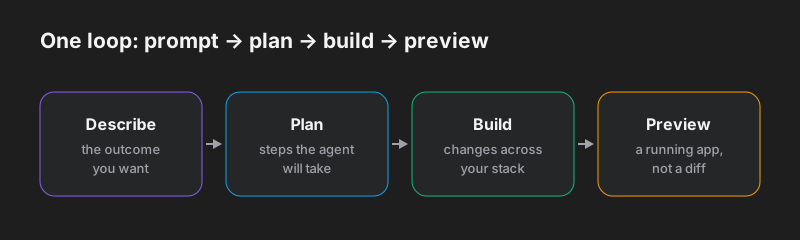
The last step matters more than it sounds. A diff tells you what changed; it does not tell you whether the thing works. When the output of every step is a running application rather than a patch, the review question changes from "does this code look right?" to "is this what I wanted?" — a question you can actually answer without reading the implementation.
Grounded, not improvised
An agent that invents plausible-looking file paths is worse than no agent at all, because you have to read everything it produces with suspicion. So before Evonx Agent writes anything, it reads.
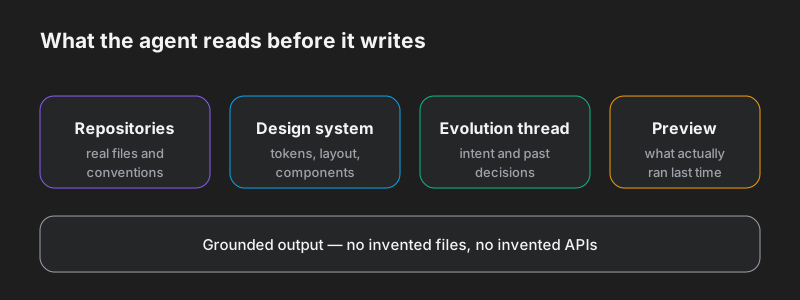
It reads your repositories, so it follows the conventions already there instead of importing habits from somewhere else. It reads your design system, so generated screens inherit your tokens and components rather than a generic template — something we go into properly in design systems that agents can actually follow. It reads the evolution thread, so decisions made three steps ago still constrain step four. And it reads the last preview, so it knows what actually ran.
Continuity between conversations
The other thing that breaks assistant-driven work is memory. You explain your architecture, get a good answer, close the tab, and the next session starts from nothing. So you either re-explain everything or accept worse output.
Evonx keeps that context in evolution threads — structured records of intent, decisions, and execution state that outlive any single conversation. Coming back to a thread after a week is not a re-explanation; it is picking up an in-progress piece of work that still knows what it was doing.
There is a practical consequence worth naming: the agent gets better as the workspace gets more specific, not as the prompt gets longer. A connected repository with clear conventions does more for output quality than any amount of instruction, because conventions are evidence and instructions are claims.
What this is not
It is worth being clear about the boundaries. Evonx Agent does not remove the need for engineering judgement, and it is not trying to. It does not merge its own work — changes arrive as pull requests you review like any other. It does not guess at things it cannot see; if the context is missing, it asks.
What it does is collapse the distance between "we should build this" and "here is the thing, running". Everything that used to sit in that gap — scaffolding, wiring, the fourth CRUD screen, the deployment fiddle — is the part worth automating. The decisions are still yours.
Where to start
Describe an outcome rather than a UI. Say who the user is, what job they are doing, and what the next step should let you check. That single habit does more for output quality than any amount of prompt engineering, and we have written up the rest of it in our practical guide to prompting Evonx.
From there, the loop takes over.