
AI speed is only useful if quality holds.
This is the part of AI-assisted development that gets discussed least, probably because it is the least exciting. Generating a feature in ten minutes is a good demo. Generating a feature in ten minutes and then spending three days working out why the edge cases are wrong is a worse outcome than having written it slowly.
The teams who get real leverage from this are not the ones who removed their engineering practices to go faster. They are the ones who kept every gate and moved the generation step inside them.
Generation belongs inside the pipeline
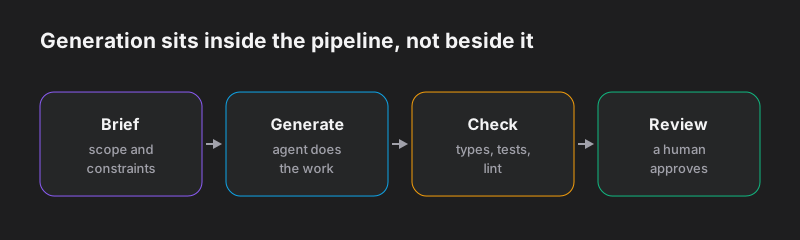
Notice what does not change. The brief still exists. The typecheck still runs. A person still reviews the diff before it merges. The agent occupies exactly the slot a developer would have occupied, and it is subject to the same conditions.
This sounds obvious written down, and it is routinely violated in practice — usually by degrees. A check gets skipped because the agent "already tested it". A review becomes a skim because the diff is large and the author was a machine. Each shortcut is individually defensible and collectively how standards erode.
Four gates worth keeping
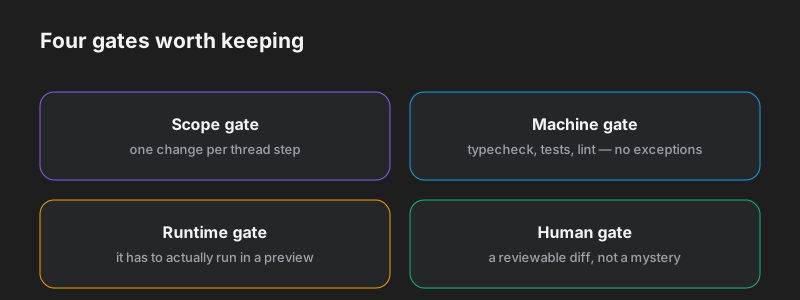
The scope gate. One change per unit of work. This is why Evonx advances an evolution thread a step at a time rather than generating a whole feature at once. A 40-line diff gets read. A 2,000-line diff gets approved.
The machine gate. Typecheck, tests, lint — with no exceptions for generated code. If anything, generated code deserves stricter automated checking, because it was written by something that cannot feel uncertain about an API it half-remembers.
The runtime gate. It has to actually run. Passing CI means the code is well-formed, not that the feature works; those are different claims. A preview is what turns the second one into something you can check in thirty seconds.
The human gate. Someone who understands the system reads the change and takes responsibility for it. Not as ceremony — as the actual point. Accountability does not transfer to a model.
Briefs do more work than prompts
The largest quality lever is upstream of generation. A vague instruction produces a plausible answer to a question nobody asked; a brief that names the constraint, the affected surface, and the definition of done produces something reviewable.
The useful discipline is writing the acceptance condition before the work starts, not after. "Done when an ops lead can find every overdue order in under ten seconds" is checkable by anyone. "Improve the orders page" is not checkable at all, which means review degenerates into taste. There is more on this in our guide to prompting.
One more thing belongs in the brief and is usually left out: what must not change. Protecting the working parts explicitly is cheaper than verifying afterwards that they survived, and it converts a whole class of regressions from something you catch in review into something that never gets written.
Higher leverage, not fewer engineers
It is worth stating the goal plainly, because the industry conversation usually gets it backwards. The point is not to need fewer engineers. It is to stop spending senior engineering time on the fourth CRUD screen, the third integration wrapper, and the migration that writes itself.
Judgement does not automate: knowing which abstraction will hurt in six months, which edge case actually matters, which requirement is wrong. Those remain the job. Everything downstream of them is increasingly not.
Teams that hold this line ship faster and keep a codebase they can still reason about a year later. Teams that trade the gates for speed get the speed first and the bill afterwards.