
Legacy application modernization services are what you buy when a business-critical system has become too risky to change and you do not have the team — or the appetite — to rebuild it yourself. The market for these services is large, mature, and unusually opaque: two vendors quoting the same project can differ by 10x, and the deliverables behind the word "modernization" range from "we moved your VMs" to "we rebuilt your product."
This guide is about seeing through that fog: what an engagement actually consists of, what the pricing models really mean, where projects fail, and how AI-agent platforms have changed what a reasonable quote looks like. If you first want the strategic background — what counts as legacy and how to choose between rehosting, replatforming, refactoring, and rebuilding — start with our practical guide to legacy modernization and come back.
What a modernization engagement actually contains
Stripped of vendor branding, nearly every serious engagement moves through the same five stages.
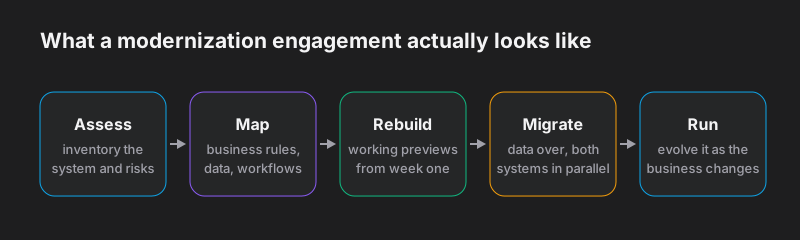
Assessment inventories the system: code (if it exists and is readable), data, integrations, users, and the risks of touching each part. Mapping is the underrated one — extracting the business rules the system enforces, including the ones nobody wrote down. This is where a good provider earns their fee, because the old system's behavior is usually the only accurate specification that exists.
Rebuild (or refactor, depending on the path) is the visible work. Migration moves the data and runs old and new in parallel long enough to trust the new one — never skip the parallel period, whatever the timeline pressure. And run is the part most contracts underweight: the system will need to keep changing after cutover, and how that happens should be decided before you sign, not after the agency's team rolls off.
What these services cost in 2026
Pricing clusters into three models, and the differences between them matter more than the headline numbers.
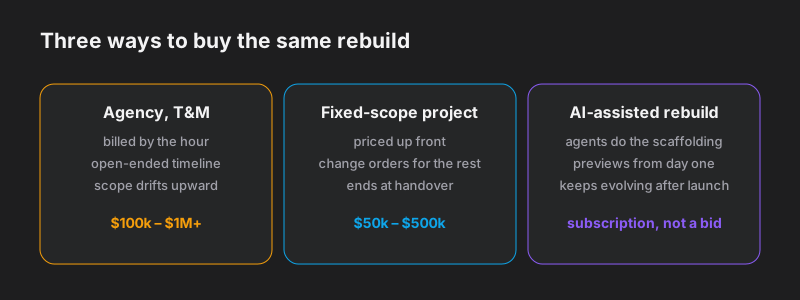
Time and materials is the traditional agency model: a blended team billed monthly. US agency rates run roughly $100–250 per hour per person; a modernization of a mid-sized business application (say, an order management system with a handful of integrations) typically lands between $100,000 and $500,000, and enterprise projects clear $1M without difficulty. The model is honest about uncertainty but gives the vendor no structural reason to finish early.
Fixed-scope projects price the work up front, usually $50,000–$500,000 for the same class of system. The risk moves into the scope document: everything discovered after signing — and in legacy work, much is discovered after signing — arrives as a change order. Budget 20–40% above the quoted figure and you will be near the true number.
AI-assisted platforms are the new column. When AI agents generate the application mass — screens, workflows, validations, reports — grounded in your actual rules and data, the labor content of a rebuild drops sharply, and the commercial model can drop with it: a platform subscription instead of a project bid. On Evonx, the flow is to describe the system (or connect its code and data), get a running preview of the rebuilt application within days, and then evolve it change by change in chat — with pricing that looks like a SaaS plan, not a construction contract. The mapping and migration stages still involve human judgment; what disappears is paying senior-engineer rates for the fourth CRUD screen.
Where modernization projects actually fail
The failure statistics for legacy projects are grim, but the causes are repetitive and mostly avoidable.
The big-bang cutover. Two years of building, one weekend of migration, no way back. Insist on incremental delivery — a working slice every few weeks that real users can try. If a vendor cannot show you something running in the first month, that tells you how the last month will go.
The spec that replaced the system. Some engagements spend six months producing a requirements document instead of software. The old system is the spec; behavior extracted and verified against it beats interviews transcribed into Confluence. Prefer providers whose first instinct is to build a testable slice, not a binder.
Rebuilding all of it. Legacy systems accrete features. Measure usage before migrating functionality — it is common to find a large minority of screens with no users at all. Carrying them forward costs money twice: once to build, forever to maintain.
No plan for after. The quiet failure mode: the project succeeds, the agency leaves, and three years later the "new" system is legacy again because nobody could change it. Modernization is not an event; it is regaining the ability to evolve. Whatever you buy, the contract should answer: who makes next year's changes, and at what cost per change?
Questions that separate serious providers from the rest
Ask every candidate — agency or platform — these five questions. The answers correlate strongly with outcomes:
1. "When do we first click on something that works?" (Good answers are measured in days or weeks.)
2. "How do you recover business rules nobody documented?" (Good answers involve the old system's observed behavior and its data, not just interviews.)
3. "How long do old and new run in parallel, and who reconciles the differences?"
4. "What does a change cost after cutover — in money and in days?"
5. "Which parts of the old system will you recommend we not rebuild?" (A provider with no answer intends to bill for all of it.)
The bottom line
Legacy application modernization services in 2026 span a wider price range than ever, because the methods span a wider range than ever. The floor dropped when AI agents took over the mechanical majority of a rebuild; the ceiling stayed where it was. The practical consequence: get at least one AI-assisted quote next to the agency quotes, and judge all of them by the same test — how quickly they can put a working, clickable slice of your system in front of you. Everything else is a promise; a running preview is evidence. And if the system in question is not an application but the company website that has drifted out of date, the same logic applies at smaller scale — we cover that in our guide to website maintenance services.