
Legacy modernization is the work of taking a system your business depends on — but can no longer safely change — and turning it back into something you can evolve. Not a museum restoration, not a lift-and-shift for its own sake: the goal is to restore your ability to say "we need this to work differently" and have that happen in days instead of quarters.
The word "legacy" makes people picture mainframes and COBOL. In practice, most legacy systems in 2026 are far younger: a PHP application from 2013 that runs the whole warehouse, a Visual Basic desktop tool the accounting team cannot live without, an Access database with two decades of customer history, or a custom portal built by an agency that no longer exists. Age is not what makes a system legacy. Loss of the ability to change it safely is.
How to tell a system has crossed the line
Nobody schedules a meeting to declare their software legacy. It happens gradually, and the signals are organizational before they are technical.
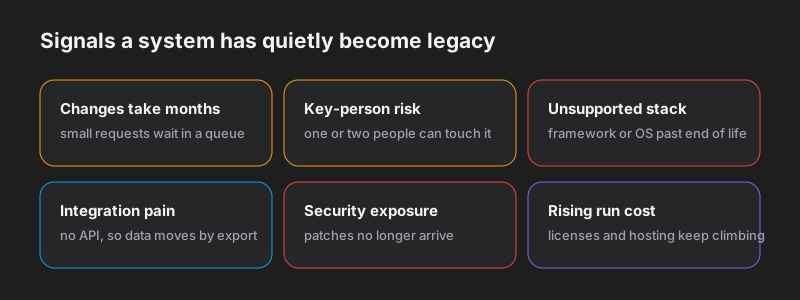
The most reliable signal is the shape of your change requests. When small asks — a new field on a form, a different tax rule, an export the bank wants — routinely take months or get answered with "we'd rather not touch that module," the system is legacy regardless of what it is written in. Close behind is key-person risk: if only one developer (or one contractor, reachable sometimes) can modify the system, every business decision that touches it inherits that bottleneck.
The technical signals matter too, and they compound. A framework past end-of-life stops receiving security patches, which turns every newly disclosed vulnerability into permanent exposure. A system without an API forces every integration through CSV exports and manual re-entry, which is where data quality quietly dies. And run costs — licenses for old databases, hosting for old operating systems, insurance riders for unsupported software — tend to climb precisely when the value of the system is flattest.
The four paths, honestly compared
Almost every modernization conversation lands on one of four strategies. They are usually presented as a menu; it is more honest to present them as a trade-off between effort and how much of the underlying problem actually goes away.
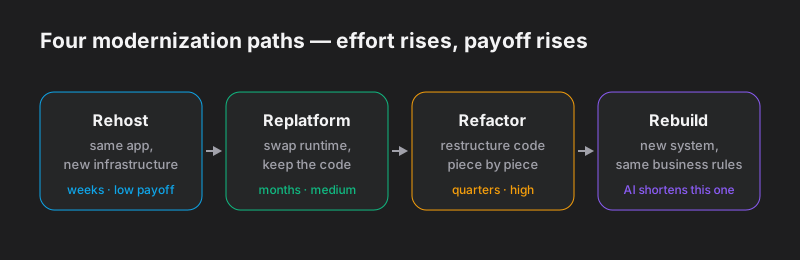
Rehost ("lift and shift") moves the application to new infrastructure — typically cloud — without changing the code. It is fast and low-risk, and it solves exactly one problem: where the system runs. If your pain is "changes take months," rehosting changes nothing. It is a reasonable first move when a data center contract is expiring, and a poor answer to anything else.
Replatform swaps the runtime underneath — a newer database, a supported OS, containers — while keeping the application largely intact. You buy security patches and operational sanity. The code, and therefore the pace of change, stays what it was.
Refactor restructures the code itself, module by module, often while extracting pieces into services. Done well, it genuinely restores changeability. It is also the path that demands the most sustained engineering discipline, because you are rebuilding the engine while driving. Teams that still have the original developers and a solid test suite can do this. Teams that have neither usually cannot.
Rebuild starts a new system that implements the same business rules, then migrates data and cuts over. Historically this was the most expensive and most feared option — the industry is full of two-year rewrites that shipped late or never. That reputation was earned in an era when every screen, every CRUD flow, and every report had to be written by hand. That era is ending.
What AI agents changed
The economics of the rebuild path have shifted more in the past two years than in the previous twenty. The expensive part of a rebuild was never the business logic — your team can usually state the rules in an afternoon. The expensive part was the surrounding mass: scaffolding, forms, validation, permissions, reports, the fourth nearly identical admin screen. That mass is precisely what AI agents are good at producing, quickly and consistently, when they are grounded in a real codebase and a real design system.
On Evonx's legacy application modernization flow, this looks concrete rather than magical: you describe the system you have — or connect what remains of its code and data — and agents produce a running application you can click within days, not a specification document. Each change request after that is a conversation: describe the adjustment, review a live preview, approve it. The rebuild stops being a two-year bet and becomes a sequence of small, verifiable steps. We wrote about the mechanics of that loop in Introducing Evonx Agent.
This does not make the hard parts disappear. Data migration is still careful work. Undocumented business rules still have to be dug out of the old system's behavior — and some of the most important ones only surface when a twenty-year veteran says "oh, that field means something different for customers from before 2015." What changes is the ratio: human attention goes to rules, data, and correctness, while the surrounding software mass stops consuming the budget.
Choosing a path: three questions
1. Where does it hurt? If the pain is infrastructure (cost, reliability, compliance), rehost or replatform. If the pain is pace of change, only refactor or rebuild will help — anything else relocates the problem.
2. What do you still have? Original developers plus tests point toward refactoring. A vanished vendor, no documentation, and a binary you are afraid of point toward rebuild — there is nothing left to refactor safely.
3. How much of the old system deserves to survive? This question is asked too rarely. Systems accrete features nobody uses. A rebuild is the one moment you can measure what is actually used and carry only that forward. Teams routinely discover that 40% of the old system's screens have no users at all.
Where to start on Monday
Do not start with a vendor. Start with an inventory: what the system does, who touches it, what it integrates with, where the data lives, and which changes have been refused or delayed in the past year. That last list is the real requirements document — it is the changeability you have already lost, written down.
Then pick the smallest slice that matters — one workflow, one report, one integration — and modernize that slice end to end before committing to the whole. Whether you do it with an agency, an internal team, or an AI-agent platform, a working slice tells you more than any assessment deck. If you want to see what the AI-assisted version of that first slice looks like, the practical details — engagement shape, costs, and what to expect week by week — are in our companion piece on legacy application modernization services.