
Website maintenance services keep a site secure, fast, and current after launch — and they are one of the most quietly resented line items in a small business budget. Resented because the value is invisible when it works, and because the market makes it genuinely hard to know whether $99 a month or $2,000 a month is the right price for your situation. Both numbers are real quotes for things sold under the same name.
This guide breaks down what maintenance actually consists of, what the price ranges mean, and where the model itself is changing — because "email your developer and wait" is no longer the only way to keep a website alive.
What website maintenance actually includes
Good maintenance is a cadence, not a reaction. The failure mode of cheap plans is that they are purely reactive — nothing happens until something breaks, which means the plan is really just discounted emergency rates.
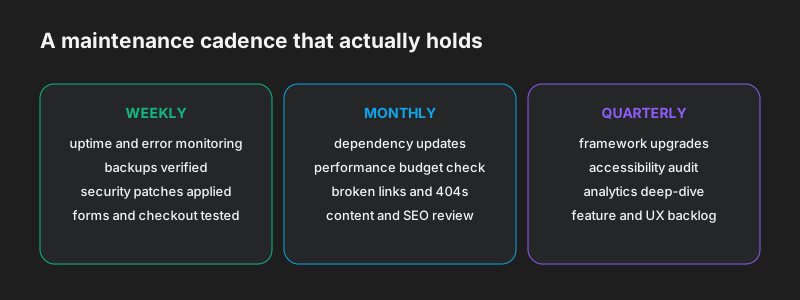
Weekly, someone (or something) should verify the site is up, errors are not accumulating, backups actually restore, security patches are applied, and the money paths — forms, checkout, booking — still work. The last one is the most skipped and the most expensive to skip: a broken contact form fails silently, and you find out from a customer who called instead.
Monthly, dependencies get updated (the plugins, packages, and libraries where most vulnerabilities live), performance gets measured against a budget rather than a feeling, broken links get fixed, and content gets reviewed — prices that changed, team members who left, that "new" product from 2024.
Quarterly is the strategic layer most plans omit entirely: framework upgrades before they become migrations, accessibility checks, a real look at analytics, and a decision about what the site should do next quarter that it does not do now. Skip this layer for three years and you have not saved money — you have accumulated a legacy modernization project in slow motion. An unmaintained website is simply a legacy system with better fonts.
What website maintenance services cost in 2026
Prices vary by site complexity — a brochure site, a WordPress site with WooCommerce, and a custom web application are different animals — but US market rates cluster into three commercial models.
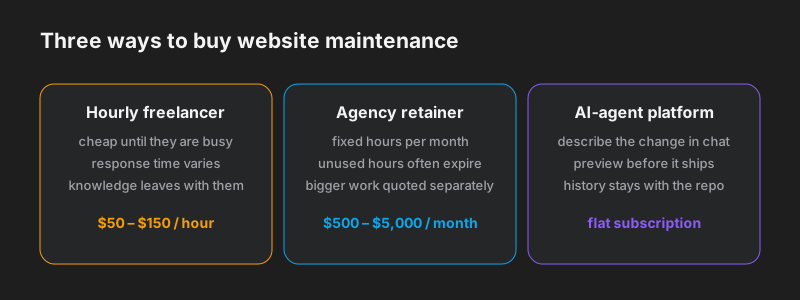
Hourly freelancers ($50–150/hour in the US) are the cheapest entry point and the most fragile arrangement. You pay only for work done — but response time depends on their other clients, and when they move on, everything they knew about your site moves with them. Reasonable for a simple site with a genuinely occasional need.
Agency retainers ($500–5,000/month for most small-to-mid businesses; e-commerce and custom applications at the top of that range or above) buy you a team, an SLA, and continuity. The catch is the retainer trap: hours that expire unused in quiet months, while anything substantial in busy months gets quoted as a separate project anyway. Read the rollover and scope clauses before signing — that is where the real price lives.
AI-agent platforms are the newest model and work differently: instead of emailing a person and waiting, you describe the change in chat — "update the pricing table," "add a testimonials section," "the contact form should also ask for company size" — and an agent implements it against your site's actual code, shows you a running preview, and ships it when you approve. On Evonx's website maintenance flow this covers content changes, new sections, and functional adjustments alike, for a flat subscription rather than an hourly meter. The knowledge-retention problem disappears too: the history of every change lives with the site, not in a departed contractor's head.
Matching the model to your site
The honest matrix is short. A static brochure site with quarterly content changes can live on a freelancer or the cheapest tier of anything. A site that is the business — e-commerce, bookings, lead generation — needs weekly cadence and someone accountable for the money paths, which means a retainer or a platform. And a site you want to keep improving (new landing pages, new sections, experiments) is where the per-change economics dominate: at agency rates, a landing page is a four-figure line item; on an AI-agent platform it is a conversation.
Two warning signs that you have outgrown your current arrangement, whichever it is: you have stopped requesting changes because of what they cost (in money or waiting), or your maintenance provider cannot tell you what they did last month. The first means the site has stopped evolving; the second means the plan is fiction with an invoice.
Questions to ask any provider
1. "What is your cadence — what happens weekly, monthly, quarterly, without me asking?"
2. "What was done on a site like mine last month? Show me the log."
3. "What is the response time for 'the site is down' versus 'please change this text'?"
4. "What happens to unused hours — and what does a new landing page cost on top of the plan?"
5. "If we part ways, what do I get — code, backups, credentials, change history?"
The last question matters most. A maintenance arrangement you cannot exit cleanly is not a service; it is a dependency. Whoever maintains your site, the code and its history should remain yours — which, incidentally, is the test that separates modern platforms and honest agencies from everyone else.
The bottom line
Website maintenance services are worth paying for — an unmaintained site degrades in security, speed, and truthfulness within months. The real decision is not whether but which model: hourly for the occasional need, retainer for accountability at scale, or an AI-agent platform when you want the site to keep evolving without a meter running. If your site has already drifted past the point where maintenance is enough — the framework is ancient, changes are scary, the developer is gone — that is a different project with a different playbook: start with our guide to legacy application modernization services instead.